Bike Sizing
How to fit a kids bike
Fitting a kids bike is five checks in order: measure the inseam, compare it to the bike's minimum saddle height, confirm standover clearance, set the saddle so they can flat-foot it, then adjust the brake levers to their hands. Nobody is going to do this for you in a box-store aisle, and it is the difference between a bike that gets ridden and one that does not.
There are five checks and they go in this order: inseam, minimum saddle height, standover clearance, saddle setting, brake lever reach. Four of the five can be done before the bike is bought, from numbers the manufacturer publishes. The fifth takes a multi-tool and ten minutes on the day it arrives.
Check 1 — measure the inseam
Not their height, not their trouser size. Stand them against a wall in socks, feet a few inches apart, and pull a hardback book up firmly between their legs so the spine sits level against the wall. Mark the top of the spine, then measure from the floor to the mark.
That figure is the only measurement in bike fitting that is actually about your child rather than about an average. The full method, with the two mistakes people make, is on how to measure your child's inseam.
Check 2 — compare it to the minimum saddle height
Every bike worth buying publishes either a minimum saddle height or a minimum inseam. The rule is simple: the bike's minimum must be at or below your child's inseam. If it is above, the bike is too big today and no adjustment fixes that.
| Wheel | Lowest fit floor in this registry | Highest fit floor | Spread |
|---|---|---|---|
| 14" | Prevelo Alpha One, 14" inseam | woom GO 2, 16" inseam | 2" |
| 16" | Prevelo Alpha Two, 15.5" inseam | woom GO 3, 19.1" inseam | 3.6" |
| 20" | Guardian 20 Small, 18.3" inseam | woom GO 4, 22.1" inseam | 3.8" |
| 24" | Guardian 24, 22" leg length | woom EXPLORE 5, 26.4" inseam | 4.4" |
Read from each manufacturer's own spec and sizing pages. The spread is why wheel size alone cannot tell you whether a bike fits.
That table is the whole reason this page exists. Two bikes with the same wheel diameter can be four inches apart on the measurement that decides whether your child can put their feet down.
Check 3 — standover clearance
With the child straddling the bike in shoes, feet flat on the floor and the bike upright, there should be clear daylight between them and the top tube. About an inch is right on a small bike, a little more on a 20 or 24 inch.
This is the check that protects them in a sudden dismount. A child who jumps off a bike with no standover gap lands on the frame. If there is no gap, the bike is too big regardless of what the saddle height says, and no amount of seatpost adjustment changes a frame.
Check 4 — set the saddle for the stage they are at
There are two correct saddle heights for a child, and which one you use depends on what they can do.
Learning: both feet flat
Drop the saddle until they can sit on it and place both feet flat on the ground with a slight bend in the knee. This is inefficient to pedal and that is fine — a beginner needs to be able to stop themselves with their feet, and confidence is worth more than pedalling efficiency at this point.
Riding: balls of the feet down
Once they can start, stop and corner, raise the saddle until they can touch the ground with the balls of both feet and the leg is nearly straight at the bottom of the pedal stroke. A knee that stays sharply bent through the whole stroke is the most common cause of a child saying cycling is tiring.
Raise it in small increments, a centimeter at a time, and never past the minimum-insertion mark on the seatpost. The detail is on the kids bike seat height guide.
Check 5 — brake lever reach
The most-skipped step, and the one that most often makes a bike feel wrong. A child should be able to wrap two fingers over the lever with their hand still holding the grip, and pull it without shifting their grip. If they have to stretch, they will not brake in time.
Most decent levers have a reach-adjust screw — a small grub screw on the lever body that pulls the blade closer to the bar. Retrospec fits reach-adjustable levers on the Koda line; woom and Prevelo specify short-reach kid-sized levers from the start. On a bike with a single-lever system like Guardian's SureStop, check the same thing on the one lever.
The two sizing mistakes that cost the most
Buying a size up so it lasts. A bike a child cannot flat-foot gets avoided for a season, and a bike that is not ridden costs the same as one that is. Buy for now and resell — good kids bikes hold their value. The symptoms of a bike that is already too big are on is my child's bike too big.
Sizing on age. Every brand prints an age band and every brand means something different by it. Prevelo and woom both say four to six for their 16-inch bikes while publishing inseam requirements 3.6 inches apart. The band is a marketing convenience, not a measurement.
Where to get fitting help if you want a second opinion
A local bike shop will fit a child to a bike for free, and it is worth doing once even if you intend to buy online afterwards — mainly so you learn what a correct standover gap and saddle height look like on your own child. The specialist direct-sale brands publish inseam-based sizing guides and most will answer a sizing question by email before you order, which is the closest thing to a fitting you can get at a distance.
Beyond that, the two reference pages on this site are the kids bike size chart for wheel size by inseam, and wheel size by age if all you have to go on is a birthday.
Re-check the fit every spring
A bike that fitted in September often does not in May. Make it a seasonal job: re-measure the inseam, raise the saddle if there is room, re-check the brake lever reach as their hands grow, and look at the standover gap. Five minutes, and it is the difference between a bike they have grown out of and a bike they say they do not like any more.
Watch for the seatpost minimum-insertion mark. If the saddle is already at that line, the frame is finished and the next adjustment is a new bike rather than a higher seat.
The picks
Every figure below is the manufacturer's own published spec, linked to the page we read it from, so you can check the one number your decision turns on — here is how we choose.
Quick picks — sorted by weight
| # | Product | Best for | Weight | Price |
|---|---|---|---|---|
| 1 | 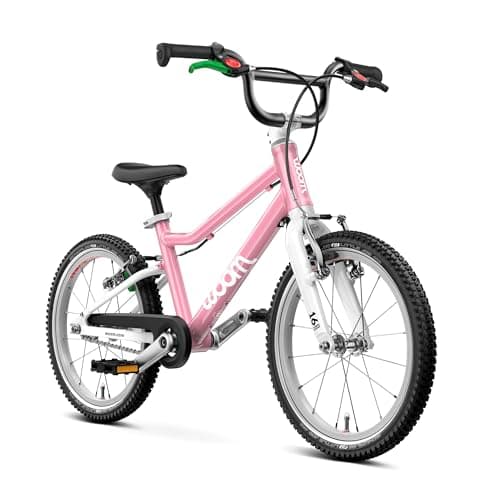 Top pickwoom GO 3 13 lb with a 19–25.1 in saddle range — the widest useful fit window of any 16-inch in this registry, on the lightest frame. | The longest fit window | 13 lb | |
| 2 | 16" Guardian 16 Inch Original The 16-inch with the lowest published minimum leg length — 16.25 in — which makes it the one to check first if your kid is between sizes. | Kids between sizes | 17.5 lb | Not sold on Amazon · Guardian Bikes specs |
| 3 | 16" Prevelo Alpha Two A 16.9 in minimum saddle on a 16-inch wheel, at 12.1 lb — it bridges the gap where a child has outgrown 14-inch but can't reach a woom GO 3. | The awkward in-between size | 12.1 lb | Not sold on Amazon · Prevelo specs |
n/p = the manufacturer does not publish that figure. Every other number here comes straight off their spec page.
Top pick — The longest fit window
woom GO 3
13 lb with a 19–25.1 in saddle range — the widest useful fit window of any 16-inch in this registry, on the lightest frame.
| Wheel | 16" |
|---|---|
| Weight | 13 lb |
| Fits inseam | 19.1–25.2 in |
| Saddle height | 19–25.1 in |
| Brakes | Two independently operated mini V-brakes |
| Gearing | Single speed, 18t front / 10t rear |
| Frame | 6061 aluminum |
| Brand says | Manufacturer says 4–6 years, rider height 41–47 in |
What works
- 13 lb — about 29% of the median six-year-old's body weight
- 6.1 in of saddle adjustment, so it lasts two seasons for most kids
- Two proper hand brakes with a color-coded rear lever
What doesn't
- 19 in minimum saddle is too high for a small five-year-old
- No gears, which starts to matter on hills around age six
- Costs three times what a big-box 16-inch costs
How we checked it: Researched from published specs · woom — GO 3 specs
#ad · How we make money · Price as of November 1, 2026
#2 — Kids between sizes
Guardian 16 Inch Original
The 16-inch with the lowest published minimum leg length — 16.25 in — which makes it the one to check first if your kid is between sizes.
| Wheel | 16" |
|---|---|
| Weight | 17.5 lb |
| Fits inseam | 16.25–23.5 in |
| Saddle height | 18.5–23.5 in |
| Brakes | SureStop single-lever hand brake; no coaster brake |
| Gearing | Single speed |
| Frame | Steel |
| Brand says | Manufacturer says 4–6 years, rider height 40–46 in |
What works
- 16.25 in minimum leg length fits kids other 16-inch bikes don't
- SureStop single-lever braking
- Kickstand, reflectors and tools in the box
What doesn't
- 17.5 lb — around 39% of the median six-year-old's body weight
- Steel frame
- Single lever means no independent brake control
How we checked it: Researched from published specs · Guardian — 16 inch Original specs
Not sold on Amazon · Guardian Bikes specs
#3 — The awkward in-between size
Prevelo Alpha Two
A 16.9 in minimum saddle on a 16-inch wheel, at 12.1 lb — it bridges the gap where a child has outgrown 14-inch but can't reach a woom GO 3.
| Wheel | 16" |
|---|---|
| Weight | 12.1 lb |
| Fits inseam | 15.5–22 in |
| Saddle height | 16.9–25.2 in |
| Brakes | Independently operated dual hand brakes, kid-sized levers |
| Gearing | Single-speed freewheel, 18t / 10t |
| Frame | Triple-butted 6061 aluminum, THRU-TUBE design |
| Brand says | Manufacturer says 4–6 years |
What works
- 16.9 in minimum saddle height — over 2 in lower than the woom GO 3
- 12.1 lb (manufacturer figure, without pedals)
- 8.3 in of saddle travel
What doesn't
- Published weight excludes pedals
- Direct-sale only
- Single speed
How we checked it: Researched from published specs · Prevelo — Alpha Two specs
Not sold on Amazon · Prevelo specs
Questions parents actually ask
01How do you fit a bike to a child?
Five checks in order: measure the inseam, compare it to the bike's published minimum saddle height, confirm there is standover clearance over the top tube, set the saddle so they can flat-foot it while learning, and adjust the brake lever reach to their hands.
02How much standover clearance should a kids bike have?
Clear daylight between the child and the top tube while they straddle the bike flat-footed in shoes — about an inch on a small bike, a little more at 20 and 24 inch. That gap is what protects them in a sudden dismount.
03Should a child be able to touch the ground on their bike?
While learning, yes — both feet flat with a slight knee bend. Once they can start, stop and corner, raise the saddle so they touch with the balls of their feet and the leg is nearly straight at the bottom of the pedal stroke.
04Can a bike shop fit a kids bike for free?
Most local shops will size a child to a bike at no charge, and it is worth doing once so you learn what correct standover and saddle height look like on your own child. Direct-sale brands publish inseam-based sizing guides and will usually answer a sizing question before you order.
Sources
Read next
- Bike SizingHow to measure your child's inseamTwo minutes, a book and a wall. The only measurement that matters.
- Bike SizingKids bike size chartWheel size mapped to inseam and height, in one table.
- Bike SizingKids bike seat heightTwo correct saddle heights, and when to move between them.
- Bike SizingIs my child's bike too big?Five checks that settle it, without a tape measure.