Helmets & Gear
How to fit a kids bike helmet
Two fingers of gap above the eyebrows, side straps forming a V just below each ear, and no more than one finger under the buckled chin strap. Then shake the head: a correctly fitted helmet moves the eyebrows, not the shell.
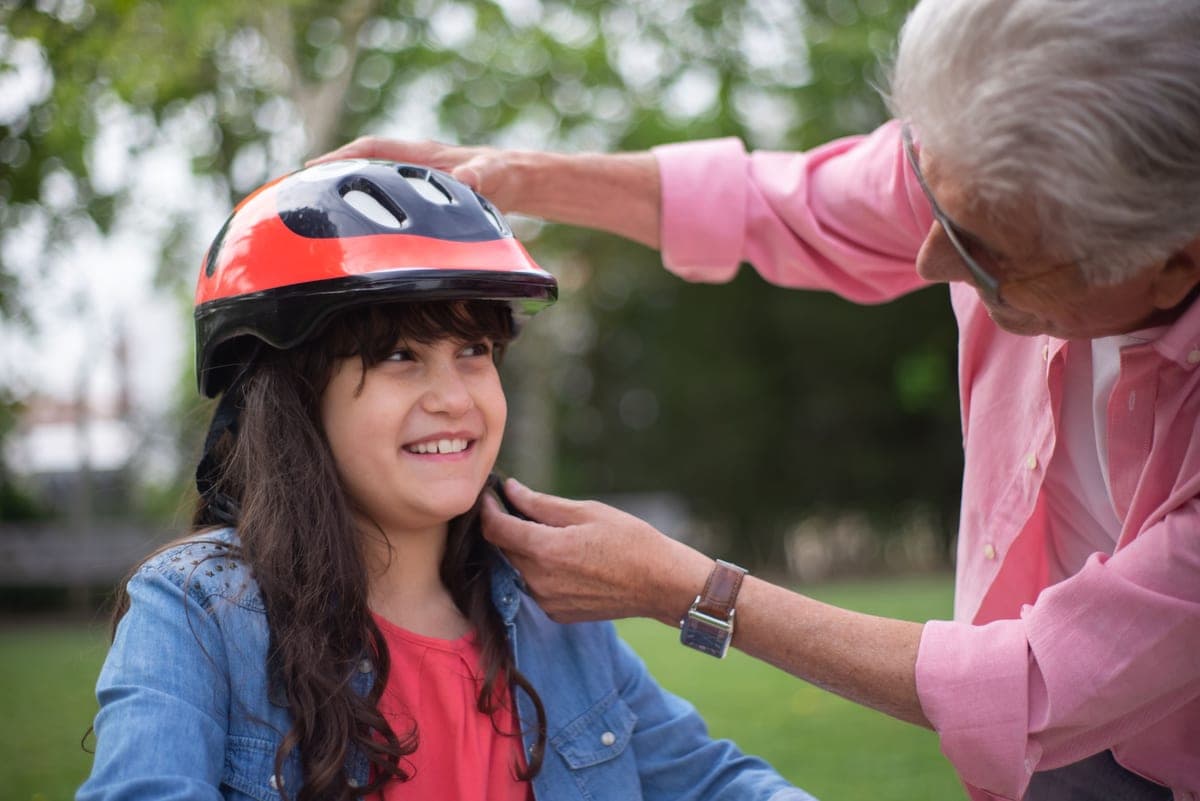
The four steps
Step 01
Position: two fingers above the eyebrows
The helmet sits level, not tipped back. The front rim should be about two of your child's finger-widths above their eyebrows. A helmet pushed back exposes the forehead, which is the part that hits things.
Step 02
Tighten the cradle until it stays put
Turn the dial (or adjust the cradle) until the helmet stays in place with the straps still undone. If the helmet only stays on because the chin strap is tight, it is the wrong size.
Step 03
Side straps: a V just below the ear
Adjust the sliders so the front and rear straps meet in a V that sits just below and slightly forward of the earlobe. This is what stops the helmet rotating forward or back.
Step 04
Chin strap: one finger, no more
Buckle it and check you can slide one finger between strap and chin, but not two. Ask them to open their mouth wide — they should feel the helmet pull down slightly.
The shake test
Ask your child to shake their head vigorously, then nod hard. The helmet should move their skin — you will see their eyebrows shift. If the helmet slides independently of their head, go back to step 2.
Re-check it every few months
Kids grow, straps slip, and dials get knocked loose in a backpack. A thirty-second re-check at the start of each season catches it. Add it to the first ride checklist each spring.
The three fit failures we see most
Tipped back
Looks comfortable, exposes the forehead entirely. The most common error and the most consequential.
Straps too loose under the chin
Two or three fingers of slack means the helmet can pivot off in a crash. One finger.
Size chosen by age
Helmet sizes are head circumference, not birthdays. The size chart takes thirty seconds and removes the guesswork.
The picks
Every figure below is the manufacturer's own published spec, linked to the page we read it from. We have not ridden these bikes and the cards say so — here is how we choose.
Quick picks — sorted by head size
| # | Product | Best for | Head | Price |
|---|---|---|---|---|
| 1 | 45–53 Top pickGiro Scamp MIPS II The XS covers a 45–49 cm head and carries the CPSC certification for age 1 and up with extended rear coverage — the combination most toddler helmets miss. | Toddlers and preschoolers | 45–53 cm | |
| 2 | 47–57 Bell Sidetrack II MIPS 320 g in youth size with a visor and Mips Evolve — the value pick once a child is past five and riding further than the driveway. | School-age riders | 47–57 cm | |
| 3 | 48–56 Nutcase Little Nutty MIPS Toddler (48–52 cm) and Youth (52–56 cm) sizes with MIPS, in the graphics kids actually agree to wear — which is most of the battle. | The helmet they'll actually wear | 48–56 cm |
n/p = the manufacturer does not publish that figure. We do not fill in a number they never gave.
Top pick — Toddlers and preschoolers
Giro Scamp MIPS II
The XS covers a 45–49 cm head and carries the CPSC certification for age 1 and up with extended rear coverage — the combination most toddler helmets miss.
| Head size | 45–53 cm |
|---|---|
| Brakes | — |
| Frame | In-mold polycarbonate shell, MIPS liner |
| Brand says | XS is CPSC certified for age 1 and older; S for age 5 and older |
What works
- XS 45–49 cm, S 49–53 cm — two sizes across the whole toddler-to-kid range
- Extended rear coverage on the XS
- Roc Loc Jr. dial fit with a pinch-guard buckle
What doesn't
- MIPS versions cost more than the plain shell
- Dial fit systems can loosen and need re-checking
Hands-on status: Researched from published specs · Giro — Scamp MIPS II
#2 — School-age riders
Bell Sidetrack II MIPS
320 g in youth size with a visor and Mips Evolve — the value pick once a child is past five and riding further than the driveway.
| Head size | 47–57 cm |
|---|---|
| Brakes | — |
| Frame | In-mold polycarbonate shell, Mips Evolve |
| Brand says | CPSC certified for age 5 and older |
What works
- Universal Child 47–54 cm and Universal Youth 50–57 cm
- 320 g in size Y, light for a helmet with rotational protection
- Removable visor for trail riding
What doesn't
- CPSC certified for age 5 and older, so it is not a toddler helmet
- Universal sizing is less precise than two distinct shells
Hands-on status: Researched from published specs · Bell — Sidetrack II MIPS
#3 — The helmet they'll actually wear
Nutcase Little Nutty MIPS
Toddler (48–52 cm) and Youth (52–56 cm) sizes with MIPS, in the graphics kids actually agree to wear — which is most of the battle.
| Head size | 48–56 cm |
|---|---|
| Brakes | — |
| Frame | Hard outer shell, crumple-zone EPS, MIPS liner |
| Brand says | Complies with CPSC 16 CFR 1203 |
What works
- Two sizes cover 48–56 cm
- MIPS across the range
- Designs kids pick themselves, so it gets worn
What doesn't
- Skate-style shell runs warmer than a vented road shape
- Heavier than an in-mold helmet
Hands-on status: Researched from published specs · Nutcase — Little Nutty MIPS
Questions parents actually ask
01How should a kids bike helmet fit?
Level on the head with about two finger-widths above the eyebrows, side straps forming a V just below each ear, and one finger of space under the buckled chin strap. It should move the scalp when the head shakes.
02How tight should a child's helmet strap be?
Tight enough that only one finger fits between the strap and the chin. Have them open their mouth wide — they should feel the helmet pull down.
03Should a bike helmet be tight or loose?
Snug. The helmet should stay in place with the chin strap undone; if it only stays on because the strap is tight, it is too big.
Sources
Read next
- Helmets & GearKids helmet size chartHead circumference to helmet size, in one table.
- Helmets & GearBest kids bike helmetsFive helmets, compared on head size and certification.
- Helmets & GearWhen to replace a kids bike helmetAfter an impact, after a growth spurt, after damage.
- Learning to RideFirst ride checklistNine checks, ten minutes, before the first ride.