Learning to Ride
How to get rid of training wheels
Do not raise them a little at a time — that teaches wobbling, not balance. Take the training wheels and the pedals off on the same day, drop the saddle so both feet are flat, and let them scoot and glide. Refit the pedals when they can coast ten seconds.
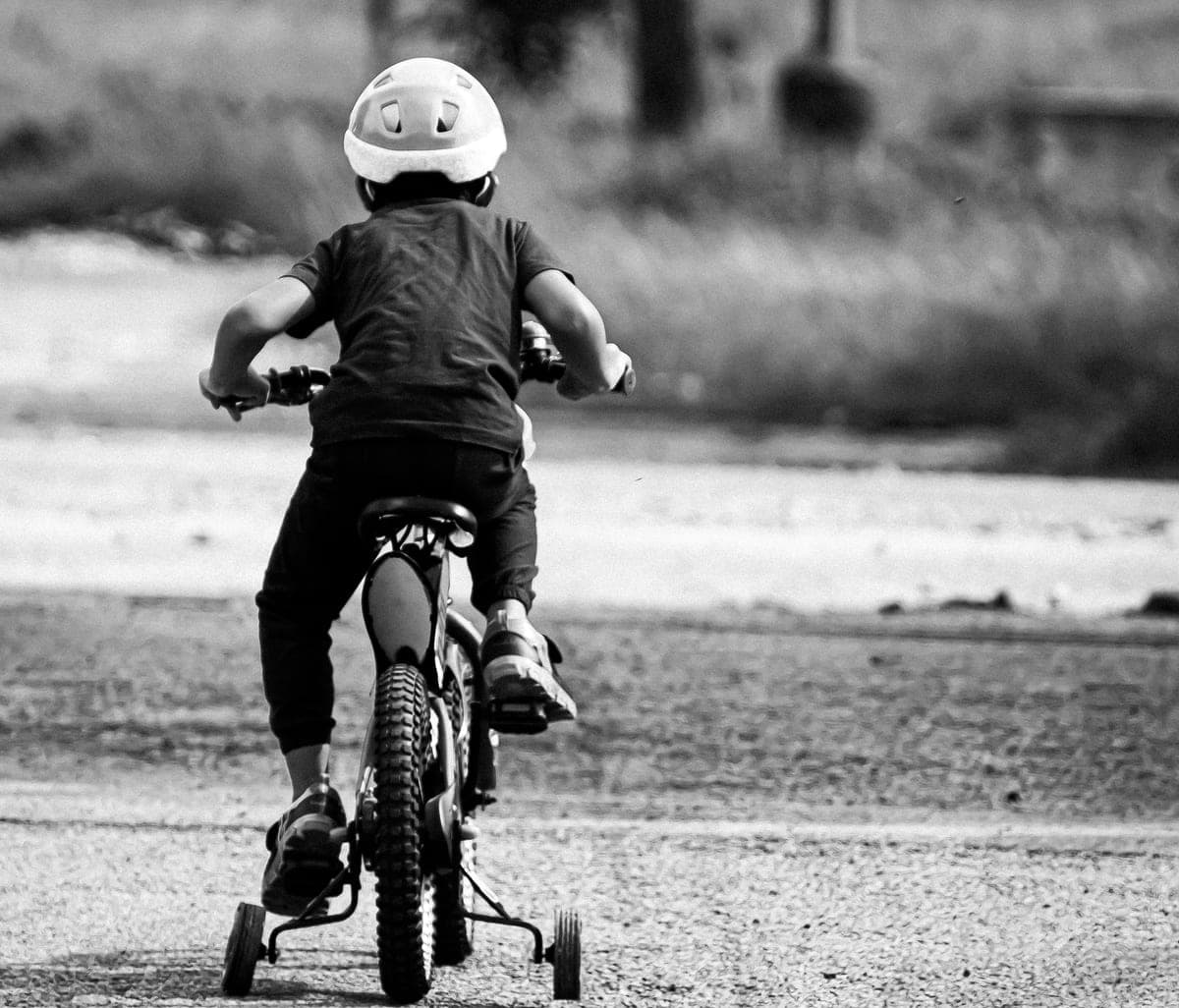
The popular advice is to raise the training wheels a little at a time so the child gets used to tipping. It sounds gradual and reassuring, and it mostly teaches a child to ride while leaning on one stabilizing wheel. Take them off completely instead, on the same day the pedals come off.
The sequence
Step 01
Weekend one, morning: everything off
Training wheels off. Pedals off — the left one is reverse threaded and loosens clockwise. Saddle down until both feet are flat on the ground while seated.
Step 02
Weekend one: walk, scoot, glide
Gentle slope, grass or quiet pavement. Walk it seated, then push and scoot, then push twice and lift the feet. Twenty minutes at a time, stopping while it is still fun.
Step 03
Weekend two: pedals back on
When they can glide ten seconds and steer, refit the pedals and raise the saddle about an inch. Teach the start position — lead pedal up at two o'clock — and hold the bike only until they push off.
Step 04
Weekend two: brakes
Stationary squeeze, then walking pace, then normal riding. A child coming off training wheels has usually only ever used a coaster brake, so a hand lever is a new skill. Why that matters is on coaster brakes vs hand brakes.
Why gradual raising does not work
A raised training wheel still catches the bike before it leans far enough to need correcting. So the child rides tipped onto one wheel, learns to rely on the catch, and never builds the reflex. You have made the bike less stable without making it a teaching tool.
Expect a step backwards first
A child who has ridden confidently on training wheels for a year will be slower and more nervous on day one without them. That is normal and it passes within a session or two. What they are losing is a false confidence; what replaces it is real.
Check the bike fits first
Training-wheel bikes are frequently bought a size up, because the stabilizers hide the problem. Before you start, confirm your child can sit at the lowest saddle setting with both feet flat. The checks are on is my child's bike too big.
The picks
Every figure below is the manufacturer's own published spec, linked to the page we read it from. We have not ridden these bikes and the cards say so — here is how we choose.
Quick picks — sorted by weight
| # | Product | Best for | Weight | Price |
|---|---|---|---|---|
| 1 | 14" Top pickGuardian 14 Inch One lever brakes both wheels, which removes the single most common first-year crash — grabbing only the front brake and going over the bars. | Braking that cannot go wrong | 16 lb | |
| 2 | 14" woom GO 2 12.2 lb on a 14-inch wheel is the number that matters here — it is the lightest first pedal bike in this registry, and a first pedal bike is mostly a weight problem. | The lightest 14-inch | 12.2 lb | |
| 3 | 14" Prevelo Alpha One 11.3 lb without pedals and a 14.75 in minimum saddle: the bike for the child who is ready to pedal before their legs agree. | Small legs, real pedals | 11.3 lb |
n/p = the manufacturer does not publish that figure. We do not fill in a number they never gave.
Top pick — Braking that cannot go wrong
Guardian 14 Inch
One lever brakes both wheels, which removes the single most common first-year crash — grabbing only the front brake and going over the bars.
| Wheel | 14" |
|---|---|
| Weight | 16 lb |
| Fits inseam | 15–24 in |
| Brakes | SureStop single-lever hand brake; no coaster brake |
| Gearing | Single speed |
| Frame | Steel |
| Brand says | Manufacturer says 3–5 years, rider height 37–43 in |
What works
- SureStop puts both brakes on one lever, in the correct order
- No coaster brake, so pedaling backwards does not stop the bike
- 15 in published minimum leg length is genuinely low for a 14-inch
- Ships nearly assembled
What doesn't
- 16 lb steel frame is ~4 lb heavier than the aluminum competition
- One brake lever means no independent rear-only braking to learn later
- Single speed only
Hands-on status: Researched from published specs · Guardian — 14 inch specs
#2 — The lightest 14-inch
woom GO 2
12.2 lb on a 14-inch wheel is the number that matters here — it is the lightest first pedal bike in this registry, and a first pedal bike is mostly a weight problem.
| Wheel | 14" |
|---|---|
| Weight | 12.2 lb |
| Fits inseam | 16–19.1 in |
| Saddle height | 15.5–19.3 in |
| Brakes | Two independently operated mini V-brakes; ships with a rear coaster brake as a CPSC requirement |
| Gearing | Single speed, 18t front / 10t rear |
| Frame | 6061 aluminum |
| Brand says | Manufacturer says 3–4.5 years, rider height 37–43 in |
What works
- 12.2 lb — roughly 34% of the median four-year-old's body weight
- Two real hand brakes with short-reach levers
- 15.5 in minimum saddle height suits a genuinely small first-pedaler
- Coaster brake can be removed by a shop if you want a pure freewheel
What doesn't
- 19.3 in maximum saddle height — a tall four-year-old will move up fast
- Direct-sale pricing
- Coaster brake ships fitted whether you want it or not
Hands-on status: Researched from published specs · woom — GO 2 specs
#3 — Small legs, real pedals
Prevelo Alpha One
11.3 lb without pedals and a 14.75 in minimum saddle: the bike for the child who is ready to pedal before their legs agree.
| Wheel | 14" |
|---|---|
| Weight | 11.3 lb |
| Fits inseam | 14–17.5 in |
| Saddle height | 14.75–25.2 in |
| Brakes | Independently operated dual hand brakes, kid-sized levers |
| Gearing | Single-speed freewheel, no coaster brake |
| Frame | Triple-butted 6061 aluminum |
| Brand says | Manufacturer says 3–5 years |
What works
- Lowest published minimum saddle height of any 14-inch here
- 11.3 lb (manufacturer figure, measured without pedals)
- True freewheel — no coaster brake to confuse the feet
What doesn't
- Published weight excludes pedals, so compare it carefully against rivals
- 14–17.5 in inseam range is narrow
- Direct-sale only
Hands-on status: Researched from published specs · Prevelo — Alpha One specs
Questions parents actually ask
01How do you transition from training wheels to a two wheeler?
Take the training wheels and the pedals off on the same day, lower the saddle so both feet are flat, and let them scoot and glide. Refit the pedals once they can coast for ten seconds.
02Should you raise training wheels gradually?
No. A raised training wheel still catches the bike before the child has to correct a lean, so the reflex never forms. Remove them entirely.
03When do kids no longer need training wheels?
As soon as they can glide and steer on a bike without pedals — which for most children is one or two sessions after the training wheels come off.
Sources
Read next
- Learning to RideDo kids need training wheels?A straight no, and the faster alternative.
- Learning to RideHow to teach a child to ride a bikeThe pedals-off method, step by step.
- Balance BikesBalance bike vs training wheelsWhy one route teaches balance and the other postpones it.
- Learning to RideFirst ride checklistNine checks, ten minutes, before the first ride.